Join Rob on Monday, July 7th, ’25 (2 +5 = 7), i.e., 777, when he will be live on Jimmy Church’s Fade to Black! Rob will be previewing Cinema Symbolism 4, the Rainbow-OZ death curse, and discussing the Crowleyan masterpieces Longlegs (2024) and Late Night with the Devil (2024) The show debuts live at 10:00 p.m. EST; to watch, click the banner:
The Rob Sullivan Experience will be live on July 7, (77) 2025, when Rob returns to Fade to Black, hosted by fellow History Channel personality Jimmy Church. The show debuts at 10:00 p.m. EST; to watch, click the banner:
After taking a small break to concentrate on my books, The Rob Sullivan Experience returns to the airwaves with an appearance on the most excellent The John Cooper Show, which debuted March 30th, 2025. Check it out!
In case you missed, Rob’s appearance of WT Frick LIVE on Friday, February 7, 2025, is now stationed on Rumble. Listen to Rob talk The Body Snatcher (1945), Longlegs (2024), Late Night with the Devil (2024), and The Wizard of Oz (1939) among other esoteric topics! Click to watch this most excellent podcast!
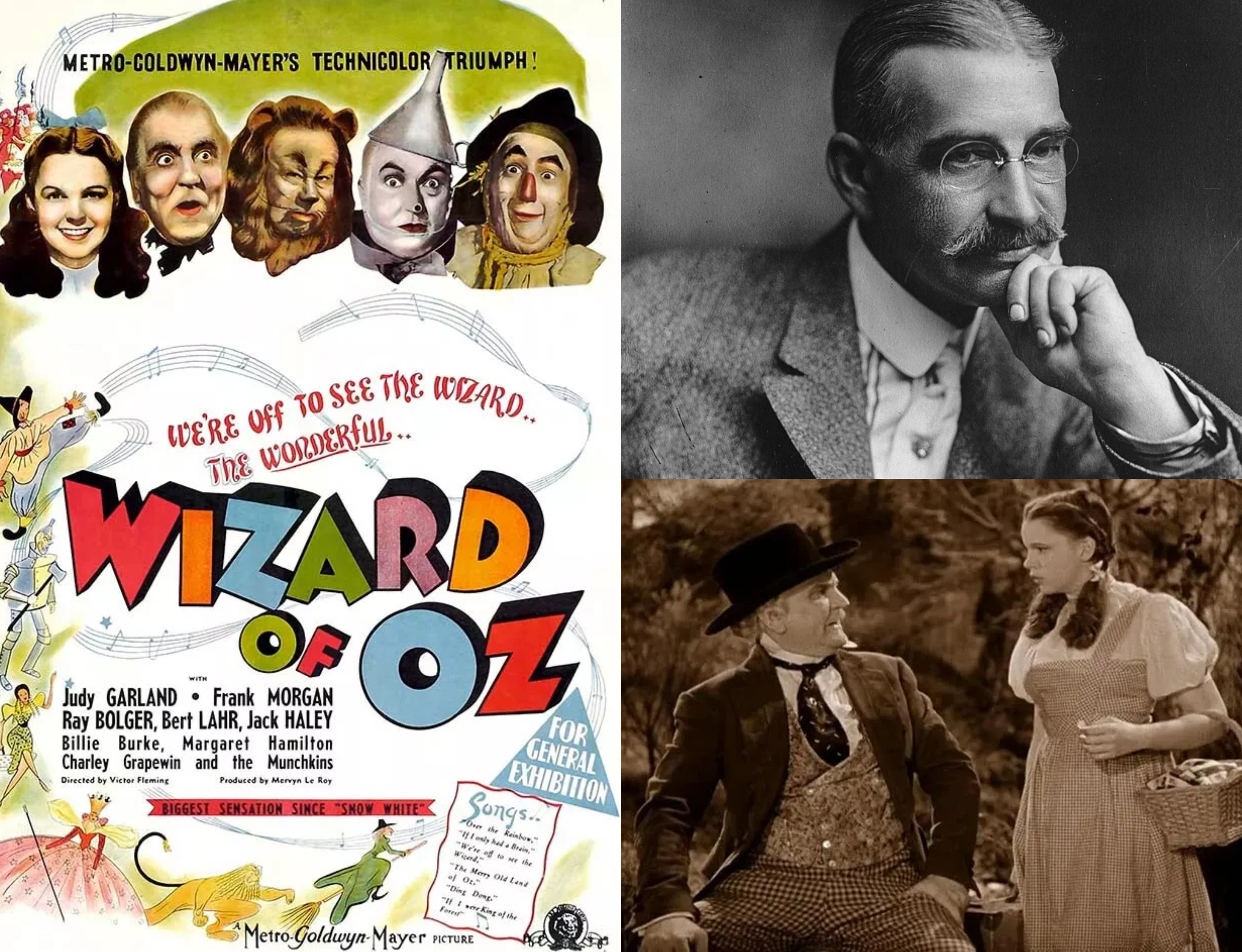
(Left) The Wizard of Oz (1939) one-sheet poster, (top right) Oz‘s author L. Frank Baum, (bottom right) Professor Marvel with Dorothy Gale in The Wizard of Oz.
An astounding Jungian synchronicity (or Swedenborgian correspondence) occurred on the set of The Wizard of Oz that defies all rational explanation. The unbelievable story was told in Aljean Harmetz’s seminal The Making of the Wizard of Oz (1977),
“For Professor Marvel’s coat,” says Mary Mayer [a unit publicist on Oz], “they wanted grandeur gone to seed. A nice-looking coat but very tattered. So the Wardrobe Department went down to an old second-hand store on Main Street and bought a whole rack of coats. And Frank Morgan and the wardrobe man and Victor Flemming got together and chose one. It was kind of a Prince Albert coat. It was black broadcloth and it had a velvet collar, but the nap was all worn out off the velvet.” Helene Bowman recalls the coat as “ratty with age, a Prince Albert jacket with a green look.”
The coat fitted Morgan and had the right look of shabby gentility, and one hot afternoon Frank Morgan turned out the pocket. Inside was the name “L. Frank Baum.”
“We wired the tailor in Chicago,” says Mary Mayer, “and sent pictures. And the tailor sent back a notarized letter saying that the coat had been made for Frank Baum. Baum’s widow identified the coat, too, and after the picture was finished we presented it to her. But I could never get anyone to believe the story.”
The story was published once–as an example of the lies press agents are willing to tell in order get a story into print.[1]
[1] Aljean Harmetz, The Making of The Wizard of Oz (1977; repr., Chicago: Chicago Review Press, 2013), 241-242.
Rob and Vadim continue their fascinating discussion about The Wizard of Oz (1939) and its nexus to the Back to the Future trilogy, John F. Kennedy (1917-1963), and President Donald J. Trump. This is the Russian dub – enjoy!
In Back to the Future III, set in 1885, the first glimpse of the courthouse’s kabalistic clock face–its clock tower–is when it is being delivered (top), displaying a time of 10:04, anticipating the November 12th, 1955, 10:04 p.m. lightning strike that will cease it from operating. When Marty and Doc pose for a picture before the clock face (bottom), the time is 8:08 or 88, the mileage necessary for the DeLorean to break the spacetime continuum. The time 10:04 is also an allusion to the date October 4th, when there are 88 days remaining to the end of the year on the solar calendar.
In Back to the Future II (1989), the Biff Tannen wax figure’s left hand (perhaps denoting the Left-Hand Path) pinches a gold horseshoe, signifying his unparalleled good luck, but generates a weird paradox, an ill omen, i.e., misfortune. The gold horseshoe appears briefly, syncing the video homage to “Mad Dog” Tannen on the monitor, foreshadowing a future event that will occur in the past. In Back to the Future III (1990), Buford shoots and kills Doc Brown over an 80-dollar dispute regarding a thrown horseshoe; in the late summer of 1885, Doc shooed Mad Dog’s horse, but when the shoe was thrown, Buford was hurled to the ground, so he shot the steed dead (valued at $75), broke a bottle of fine Kentucky Red Eye Whiskey (worth $5) that he was drinking, and wants Doc to recompense him for both. Cinema Symbolism Third Edition is coming along nicely.
Gunpowder, treason and plot. I see no reason why gunpowder treason should ever be forgot. This Bonfire Night, make The Royal Arch of Enoch (2nd Ed., 2016) your autumn reading material, and learn more about the Jesuits, Guy Fawkes (1570-1606) the Counter-Reformation, and the kabalistic origins of the High Degrees of Freemasonry. To get your copy (print of Kindle), click the image:
V (Hugo Weaving, right) in V for Vendetta (2005) wears the mask of Jesuit agent Guy Fawkes (left).
Rob returns to The Farm for his annual Masonic-Halloween Special 2024! Hosted by Recluse, and running 49 minutes long (72), Rob talks Immaculate (2024) and The First Omen (2024) in this spooktacular Samhain podcast! To listen to this show, click the banner: