As Cinema Symbolism 4 nears completion, I will share a teaser from Chapter V called “Alchemical Hollywood.” I believe I may have posted some of this before, but here it is regardless. I should be done writing it the first week of September 2025, but then have to start the editing and formatting process. In the meantime, enjoy!
Hermes is the spirit of alchemy because he is a deity of complete being, revealing what many forget in their inhabitation of a half-world: chaos and the ocean are the secret grounds of the cosmos and the city. Actress Audrey Hepburn was paired with a paragon of the citrinitas, Fred Astaire (1899-1987), who was always searching for the goddess Terpsichore, in the musical romantic comedy Funny Face (1957). Hepburn, who plays Jo Stockton, an albedo exemplar, is both sprite and diva, embodying the nigredo and rubedo, i.e., she is a bashful melancholic bookseller and vivacious supermodel; in 36 seconds of film (Master Therion’s qabalistic number for Mercurius), she successfully performs alchemy, forever turning from mere mortal into everyone’s ideal goddess when she descends the marble staircase in the Louvre, swathed in a red Givenchy gown, signifying the spagyric art’s rubedo, with her crimson scarf flying around the pagan statue The Winged Victory of Samothrace, transmogrifying her into Nike if only temporarily.
The spagyric art pervades pop culture, but before delving into cinema, let us revisit CS2 and explore the most excellent alchemical-Masonic music video ever made: Gloria Estefan’s “♫ Live for Loving You ♫,” which was the fourth and last single from her third solo album, the Luciferian titled Into the Light (1991). The video opens with an Enochic sun rising over a black and white checkered floor, evoking Solomon’s Temple and the Threshing Floor of Ornan the Jebusite, recalling not only the First Temple, but also the construction of the Second Temple, i.e., the Temple of Zerubbabel, the purview of Masonry’s high degrees. The video’s director then appears before the rising sun, incarnating as a cigarette-smoking flamingo between two palm trees, representing the Pillars of Enoch, thereby transmogrifying into a living Royal Arch Word, the Tetragrammaton, which implies that the music video is a Masonic production. Owls and serpents, i.e., wisdom totems, appear throughout the music video, signifying esoteric Masonic knowledge that is veiled in both the Blue Lodge and high-degree rituals. In a rainforest, Gloria starts as an unassuming earth goddess but, as the video progresses, she exhibits all the colors of alchemical transition, specifically black, white, and red dresses; at one point, she drives a red car with a black and white dog sporting a red scarf tied around its neck. Gloria Estefan dons a white bathrobe alluding to the albedo, a sexy black ensemble representing the nigredo, and a sleek yellow bodysuit, embracing the citrinitas and betokening her animus, while relaxing in a rickshaw pulled by an Apollonian male, the sun. Gloria must conclude the alchemical process she began by becoming the rubedo, shrouded in the nigredo, as they often taint each other. Thus, Gloria wears a sleek and sultry red dress and high heels, indicating completion of the magnum opus, while sitting on a nocturnal crescent moon, the supreme symbol of the sacred feminine, i.e., the albedo. The great work finished, Gloria has transitioned from a telluric numen to a majestic lunar goddess like Isis, Diana, Hecate, and Artemis, transcending the Earth and its inhabitants by becoming Mozart’s apotheosized Queen of the Night, ruling in the starry canopy above.[1]
[1] See this author’s Cinema Symbolism 2 and The Royal Arch of Enoch.
(Left) Gloria Estefan achieves the rubedo, enveloped in the nigredo, at the conclusion of the music video for her song, “♫ Live for Loving You ♫.” (Right) The cover of Gloria Estefan’s Greatest Hits depicts the Cuban-American singer in a white blouse, representing the albedo, i.e., her femininity, and wearing red high heels, fishnets, and a fairy tutu dress, the rubedo, because the album is the culmination of her career, at least up to the early 1990s. Easter egg: the album was released on October 30, 1992, this author’s twenty-first birthday.
Part IV is coming along really well, and I am anticipating a Spring 2025 release. However, movies that still must be viewed include The Nun II, The First Omen, Late Night with the Devil, Immaculate, and Joker: Folie à Deux. In the meantime, here is a little teaser:
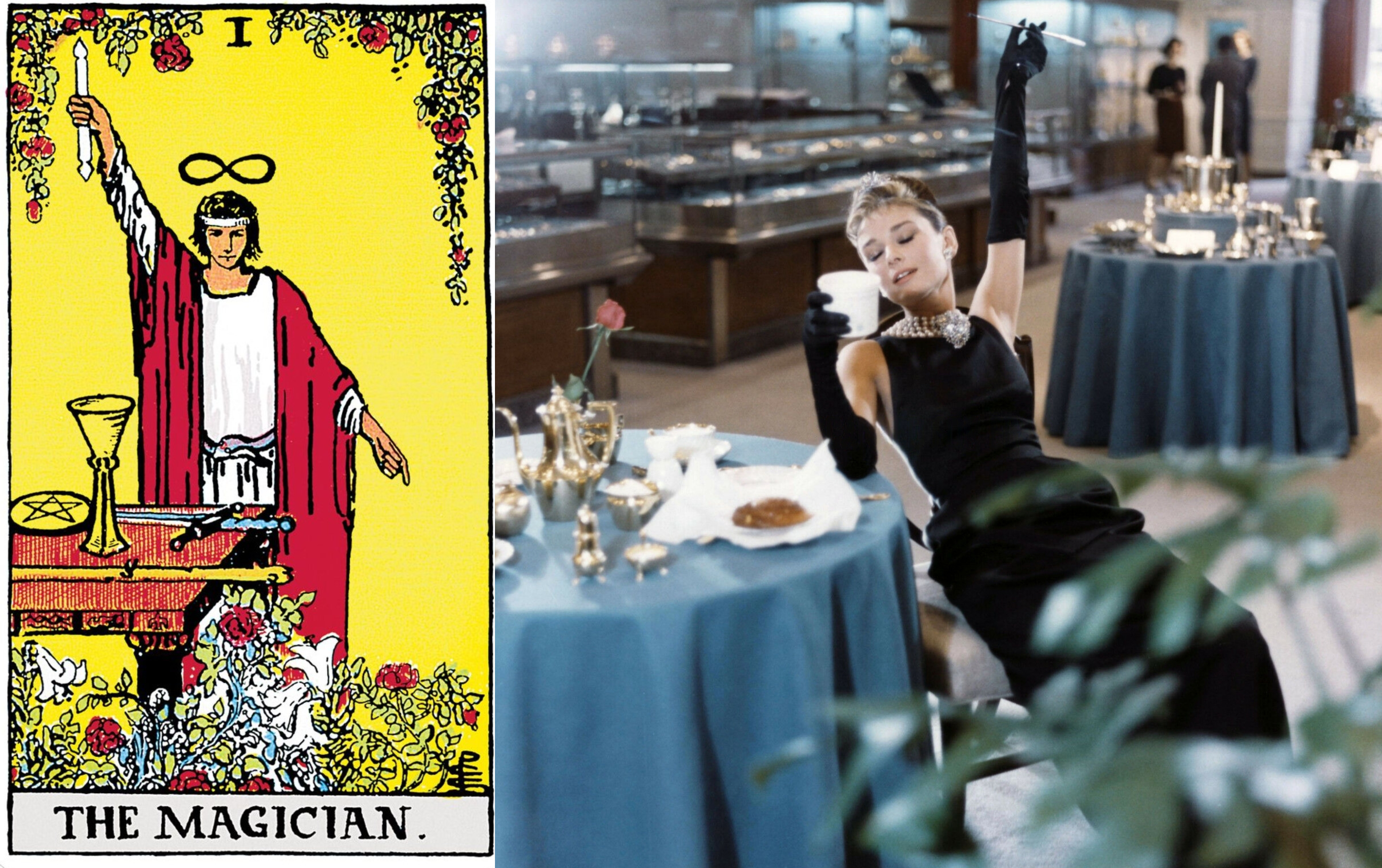
(Left) The Tarot’s Magician qua Mercurius is alchemy’s change agent and archetypal trickster, becomes Breakfast at Tiffany’s bewitching Holly Golightly (right, portrayed by Audrey Hepburn, 1929-1993), a paragon of the Magician’s feminine ambivalence because, in matters of the heart, Holly can never make up her damn mind. She impersonates the Magician’s arm posture–as above, so below–with her elongated cigarette holder as her wand. The clothes make the woman: dressed in Saturnian black, the alchemist’s lead, Holly is a melancholic who suffers from acute anxiety, the hellish “reds” indicating the rubedo is the nigredo, yet as a bunco artist, she easily manipulates the men in her life, bending NYC’s chic social scene to her will. Holly’s breakfast table mimics that of the Magician, complete with a rose–the Magician stands in a garden of white lilies and red roses denoting the Rosicrucian mysteries–linking Holly to the Greco-Roman goddesses of beauty, Aphrodite and Venus, and three of the four tools of the Magician, i.e., the four Tarot suits, also manifest, viz., the coin/pentangle qua pastry, the goblet qua cup, and the sword qua knife (only the rod is absent). Above the Magician is the lemniscate, which is the number eight turned sideways; applied to Holly Golightly, it represents the ogdoad, the sphere of divine wisdom, Sophia, who can also play the role of a duplicitous woman, a mountebank.
My latest book is coming along exceptionally well, so here is a little teaser to whet everyone’s appetite; enjoy, as this will be the last one for a while. Also, stay tuned also for more interviews on a variety of topics, including Rob’s annual Masonic Halloween Special and a National Treasure deep dive.
“The ordeals thou shalt oversee thyself, save only the blind ones. Refuse none, but thou shalt know & destroy the traitors. I am Ra-Hoor-Khuit; and I am powerful to protect my servant. Success is thy proof: argue not; convert not; talk not over much! Them that seek to entrap thee, to overthrow thee, them attack without pity or quarter; & destroy them utterly. Swift as a trodden serpent turn and strike! Be thou yet deadlier than he! Drag down their souls to awful torment: laugh at their fear: spit upon them!” (AL III:42). So why did this skinwalker/Native American death hex latch onto Aleister Crowley’s Qabala, the new era’s prophet? Two of Crowley’s preeminent numbers for this neo-astrological epoch are, quite literally, The Wizard of Oz, designating the Æon of Horus/Aquarius. The first is 77, OZ, the new solar messiah, the Goat of Mendes, and the second is 42, the deathblow, symbolized by the rainbow, as in “♫ Over the Rainbow ♫,” baptized the Dark Mother by Master Therion, the destructive elemental linked to the devil Chronzon, whose number is 333 (vide supra). According to Aiwass, the new Æon began in 1904; adding a cusp phase, it is apparent that the Piscean Age terminated on September 11th, 2001, commencing the Horus/Aquarian Age proper because sevens are omnipresent, signifying Baphometic diablerie. For instance, the date has a reverse ordinal value of 154 = 77 x 2,[1] and the month’s name comes from the Latin septem, meaning seven, as it was originally the seventh of ten months on the ancient Roman calendar; thus, septem multiplied by the day of the week is 7 x 11 = 77, making it the day of the Goat. The Dark Mother, the multicolored arch, 42, was also very busy on 9/11; for example, at Newark International Airport (now Newark Liberty), Flight 93 was delayed 42 minutes on the runway before takeoff. But this was not the first time OZ and the rainbow reared their ugly heads on 9/11. Forty-four years earlier, the number of Horus and a digit Crowley links to blood sacrifice, on September 11th, 1957, ABC aired preview segments of the Rainbow Road to Oz on Disneyland’s fourth-anniversary show, but the project was shelved a few months later. Forty-four is also connected to the World Trade Center because it opened on the fourth day of April, the fourth month, 44, of 1973, which reduces to the number two (1 + 9 + 7 + 3 = 20 = 2 + 0 = 2), indicating twins or doubles, implying the WTC complex was constructed to be nothing more than a vessel to house burnt offerings to Horus qua the Goat of Mendes. On that same date, the demons from the Qliphoth were summoned via an Apollonian megastar: on the evening of April 4th, 1973, NBC aired Elvis’ Aloha from Hawaii via Satellite concert, the highest-rated program of the year, which was recorded at the Honolulu International Center (now the Neal S. Blaisdell Center), located at 777 Ward Avenue. April 4th, 1973, also anticipated the total lunar eclipse of April 4th, 1996; the blood moon, becoming a mark of the Ruby Slippers, signifies calamity, the destruction of all things, and the end of the world qua solar age.[2] This blood moon, in turn, foreshadowed the partial lunar eclipse of July 28th, 1999, with Diana/Artemis/Hecate reigning supreme in Aquarius, i.e., heralding the new age, 777 days before September 11th, 2001, when Christianity (the worship of the sun in Pisces), Islam (the worship of Venus), and Judaism (the sun in Aries mingled with the adoration of Saturn) became obsolete, but the Luciferian godhead lives! “The year is one!” – Roman Castevet/Steven Marcato, Rosemary’s Baby. And speaking of Luna, on September 11th, 2001, the moon was a waning crescent in the house of Gemini the Twins, fading away, signifying the two towers vanishing from NYC’s skyline. Easter egg: Baphomet and the Dark Mother made a cameo appearance with Bonesman and President George W. Bush on the morning of 9/11, as he was reading the short story “The Pet Goat” by American educationalist Siegfried “Zig” Engelmann (1931-2019) anthologized in the classroom workbook Reading Mastery: Rainbow Edition, Level 2, Storybook 1 (1994) to Floridian schoolchildren.
Gemini the Twins’ two brightest stars, Castor and Pollux, represent the mythological twin brothers of Helen of Troy, corresponding with Jachin and Boaz of Solomon’s Temple, and the Pillars of Hercules: the two promontories at the eastern entrance to the Strait of Gibraltar, a narrow opening 14 kilometers wide (7 doubled or 77) between the Mediterranean Sea and the Atlantic Ocean, separating the continents of Africa and Europe. Its glyph symbolizes two pieces of wood bound together, and its ruling planet is Mercury, alchemy’s destroying agent.
For reasons unknown, the death curse remained dormant until The Wizard of Oz began filming in 1938, evidenced by all the accidents that occurred on set, suggesting it was hexed, as this is when 77, the Goat, its play backed by 42 and sometimes 333, la Madre Oscura and Choronzon, appeared on the scene, identifying itself as the God of the new age, desiring death, annihilation, and bloodshed, ascending to the divine solar throne on 9/11. To begin with, the film’s starlet, Judy Garland, started consuming amphetamines and barbiturates, which allowed her to stay thin and energized, but it turned her into a dope fiend, putting her in an early grave at 47. Buddy Ebsen, the original Tin Man, nearly died when aluminum powder got into his lungs, sending him to the hospital for two weeks and forcing him to drop out. The Wicked Witch of the West, Margaret Hamilton, was severely burned, and her stunt double, Bertha “Betty” Danko (1903-1979), suffered two accidents. The first was minor, hurting her back, but it was the second, during the SURRENDER DOROTHY skywriting scene, that a pipe attached to Witch’s broomstick exploded, landing her in a hospital bed with a dreadful leg injury. Then there is the old urban legend that a midget portraying one of the Munchkins committed suicide on the set, visible in the background when Dorothy, Scarecrow, and the Tin Man cavort down the Yellow Brick Road, leaving the latter’s hovel behind. Is it a dead dwarf or a stork? Regardless, The Wizard of Oz was released to the public on August 25th, 1939, seven days before the outbreak of WWII.
“The Tarot figures, in various guises, are ever present in our lives. By night they appear in our sleep, to our mystification and wonder. By day they inspire us to creative action or play tricks with our logical plans.” – Sallie Nichols, Jung and Tarot: An Archetypal Journey, 1980. Two Tarot cards that came to life on 9/11. (Insert Top Left) The lightning-struck Tower, card XVI from the Rider-Waite deck, is the Twin Towers destroyed. Its background is black, linking it to the Devil card (see Introduction), which has the same dark setting. Alchemically, the Devil represents the nigredo phase, the psychological dark night of the soul, the blackening and decay stage of the Great Work, in which material reality needs to be purified to make way for something fresh, in this case, the new yet bleak Æon of Horus. The falling person to the left of the Tower is shaped like the Hebrew letter ayin ע, and the figure on the right forms zayin ז, producing 77, OZ, the Goat of Mendes, synonymous with the Devil card. The Tower betokens transformation, the shattering of illusions, and abrupt, discomforting, and unsettling change, indicating the shift from Pisces to Aquarius. (Insert Bottom right) The Hanged Man, signifying the mystery of death (of the old age) and the riddle of resurrection (of the new), also denotes the Tower’s transmogrification, death, and rebirth. The twelfth trump becomes The Falling Man, plummeting to his death, having jumped from the WTC’s North Tower. Like the Tower card, alchemy has been a critical influence on the interpretation (one of many) of the Hanged Man. Lévi described him as “the great and unique athanor, which all can use, which is ready to each man’s hand, which all possess without knowing it.” The athanor is an alchemist’s furnace; the first stage of making the Philosopher’s Stone culminated in the nigredo phase when the material in the alchemist’s vessel was destroyed by heating it and driving off vapor, which was regarded as its spirit or spark of life. Then, the haze was allowed to condense and saturate the dead material, resurrecting it in a new and improved form; on 9/11, death and destruction signaled the end of Pisces, Christ the fisherman, the sun reborn in Aquarius as Baphomet, the Saturnian Bleating Goat.
Hermes is the spirit of alchemy because he is a deity of complete being, revealing what many forget in their inhabitation of a half-world: chaos and ocean are the secret grounds of cosmos and city. Actress Audrey Hepburn (1929-1993) was paired with Fred Astaire (1899-1987)–who was always searching for the goddess Terpsichore–in the musical romantic comedy Funny Face (1957). Hepburn, who plays Jo Stockton, is both sprite and diva, bashful bookseller and supermodel; in thirty-six seconds of film (Master Therion’s qabalistic number for Mercurius), she performs alchemy, forever turning from mere mortal into everyone’s ideal goddess when she descends the marble staircase in the Louvre, swathed in a red Givenchy gown, signifying the spagyric art’s rubedo, with her crimson scarf flying around the pagan statue The Winged Victory of Samothrace, which in alchemical cinema, transmogrifies her into Nike herself. From Cinema Symbolism 4.
Rob returns to Richard Syrett’s Strange Planet podcast to analyze occult symbolism in film, movies like Halloween Ends (2022) and Pearl (2022), and to identify the location of JFK’s missing brain. Watch now this most excellent show!
Ti West strikes with Pearl (2022), a fantastic film that’s a blend of alchemy, a dash of The Wizard of Oz (1939), and throw in Lizzie Borden (1860-1927) for good measure. Not to mention a guest appearance by the Goat of Mendes. Check it out!





 Robert W. Sullivan IV